FDA's QMSR is in force: what ISO 13485 alignment means for device makers
Since 2 February 2026, 21 CFR Part 820 incorporates ISO 13485:2016 by reference. This guide explains what FDA added on top of the standard, which records are now inspectable, how risk-based inspections replaced QSIT, and what it means for EU manufacturers.

Since 2 February 2026, FDA's device quality requirements in 21 CFR Part 820 have been the Quality Management System Regulation (QMSR). The QMSR incorporates ISO 13485:2016 by reference and adds a short set of FDA-specific provisions on definitions, links to other FDA regulations, records, and labeling and packaging. On the same date, FDA stopped using its Quality System Inspection Technique (QSIT) and moved to a risk-based inspection process, and management review, internal audit and supplier audit reports became open to inspection. If your QMS already conforms to ISO 13485, most of the work is in those FDA additions and in preparing for a different style of inspection, not in rebuilding the system.
This article explains what the QMSR contains, what FDA kept from the old Quality System (QS) regulation, how inspections now work, and what it means for EU and Belgian manufacturers that sell devices in the United States.
What the QMSR is
FDA published the final rule in the Federal Register on 2 February 2024 and gave manufacturers two years before it took effect on 2 February 2026 (Federal Register, FDA FAQ). The rule renamed Part 820 and replaced most of its old sections with a reference to ISO 13485:2016, plus clause 3 (terms and definitions) of ISO 9000:2015 (FDA).
The new Part 820 is short. In the current text, the operative sections are (eCFR):
- 820.1 Scope, including the rule that where ISO 13485 conflicts with the Federal Food, Drug, and Cosmetic Act (FD&C Act) or its regulations, the US law controls.
- 820.3 Definitions, which adopts the ISO definitions with FDA overrides.
- 820.7 Incorporation by reference of ISO 13485:2016 and ISO 9000:2015 clause 3.
- 820.10 Requirements for a quality management system.
- 820.35 Control of records.
- 820.45 Device labeling and packaging controls.
Note the edition. FDA incorporated ISO 13485:2016 specifically. FDA has said that if ISO 13485 is revised, it will evaluate the changes and may amend the QMSR through rulemaking (FDA FAQ). A new ISO edition does not automatically become a US requirement.
What FDA added on top of ISO 13485
Definitions: US law wins
Under 820.3, the FD&C Act definitions of terms such as "device" and "labeling" replace the ISO 13485 equivalents. FDA also defines "manufacturer" broadly (including contract sterilisers, relabellers, specification developers and initial distributors of foreign entities), states that "organization" in ISO 13485 means the manufacturer, and states that "safety and performance" means "safety and effectiveness" (eCFR). In practice, an ISO 13485 quality manual written for the EU usually needs a short US annex that applies these definitions.
Links to other FDA regulations
Section 820.10(b) ties specific ISO 13485 clauses to other parts of Title 21. Identification under clause 7.5.8 must follow the UDI rule (Part 830). Traceability under 7.5.9.1 must follow device tracking (Part 821) where applicable. Reporting to regulators under 8.2.3 means medical device reporting under Part 803. Advisory notices under 7.2.3, 8.2.3 and 8.3.3 must be handled under the corrections and removals rule (Part 806) (eCFR).
Design and development scope
ISO 13485 clause 7.3 applies to class II and class III devices, to class I devices automated with software, and to a short list of other class I devices named in 820.10(c). Under 820.10(d), manufacturers of devices that support or sustain life must also meet the implantable device traceability requirements of clause 7.5.9.2 (eCFR).
Records: complaints, servicing and UDI
Section 820.35 adds to ISO 13485 clause 4.2.5 (control of records). For complaints that must be reported under Part 803, that you decide to investigate, or that you investigated anyway, the record must include the device name, date received, any UDI or UPC, the complainant's name, address and phone number, the nature and details of the complaint, any correction or corrective action, and any reply to the complainant. If you do not investigate because a similar complaint was already investigated, you must record the justification. Servicing records need the device name, any UDI or UPC, date, the person who serviced it, the service performed and test and inspection data. The UDI must be recorded for each device or batch (eCFR).
Check your complaint form against that list field by field. An EU complaint process built to ISO 13485 and the MDR can easily miss one item, such as the reply to the complainant or the UPC. If you record complaints and investigations in an eQMS, make these fields mandatory on the complaint form so they cannot be skipped. See how events and complaints can be captured with structured fields and linked investigations.
Labeling and packaging controls
Section 820.45 keeps the substance of the old labeling controls. Manufacturers must have procedures covering the integrity, inspection, storage and handling of labeling and packaging. Labeling and packaging must be examined for accuracy before release or storage, including the UDI or UPC, expiry date, storage and handling instructions and any additional processing instructions. The release of labeling must be documented, operations must prevent mix-ups, and the results of labeling inspection must be documented (eCFR).
Records that are now open to inspectors
Under the old QS regulation, section 820.180(c) shielded management review, quality audit and supplier audit reports from routine FDA inspection. That exception was not carried into the QMSR. FDA's FAQ says these reports are now subject to inspection and should be readily available (FDA FAQ).
This is the change many quality teams underestimate. Internal audit reports written on the assumption that FDA would never read them may contain loose wording, findings with no follow-up, or opinions about people. From now on, write audit and management review records as if an investigator will read them, because one may. That does not mean softening findings. It means stating facts, linking each finding to a corrective action, and showing that the action was completed and checked. Our guide to CAPA effectiveness checks covers that last step.
FDA has also said investigators may review records created before 2 February 2026, and that a comparative analysis showing those records meet QMSR requirements may help (FDA FAQ).
QSIT is gone: how inspections work now
On 2 February 2026, FDA stopped using QSIT and began using the inspection process in Compliance Program 7382.850, Inspection of Medical Device Manufacturers (FDA). The compliance program organises QMSR requirements into six QMS areas and four other applicable FDA requirements, with patients, users and product risk at the centre (CP 7382.850).
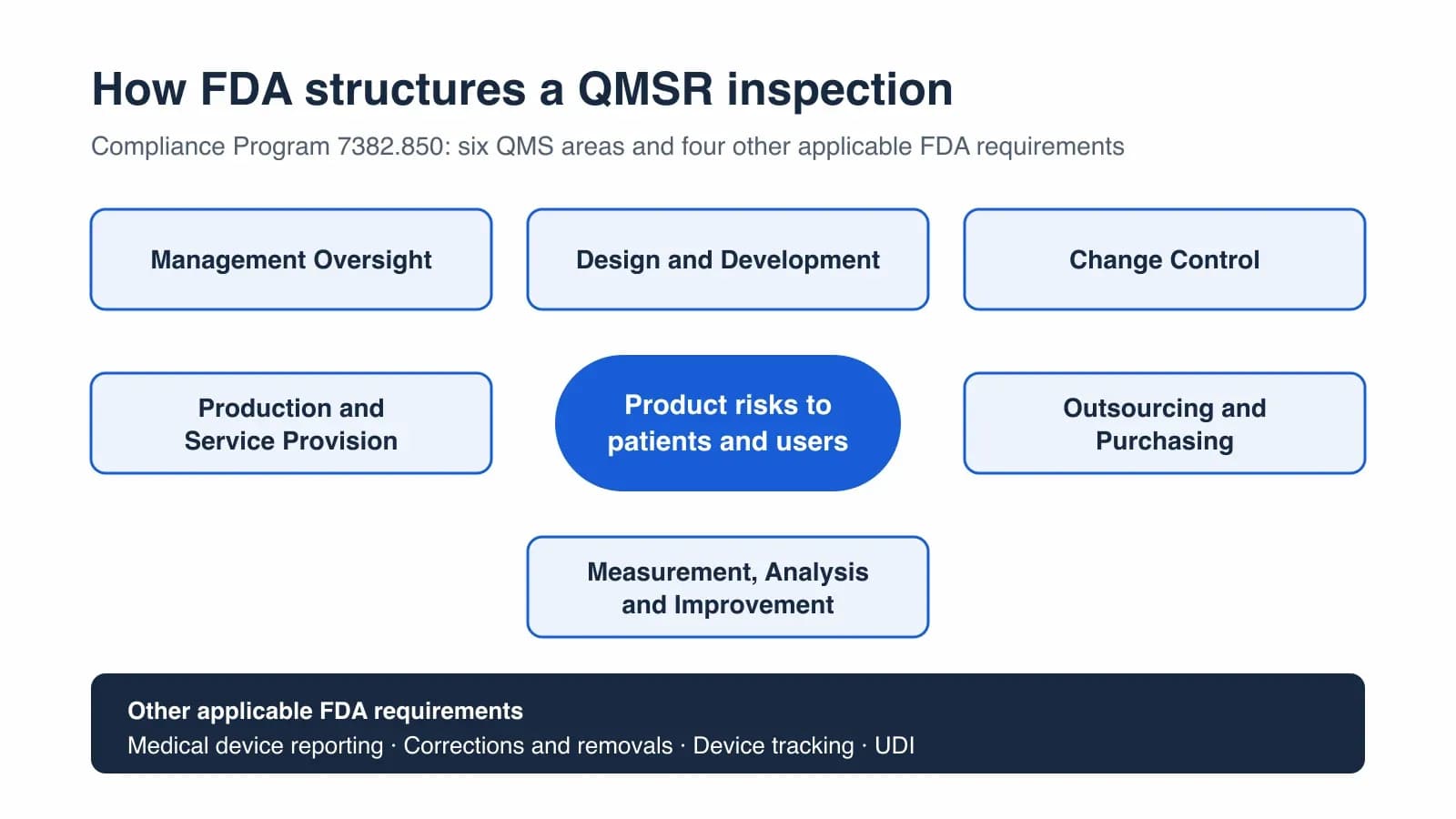
The six QMS areas are Management Oversight; Design and Development; Change Control; Production and Service Provision; Outsourcing and Purchasing; and Measurement, Analysis, and Improvement. The four other applicable requirements are medical device reporting, reports of corrections and removals, device tracking and UDI. Registration and listing, marketing authorisations and previous compliance issues remain in scope.
The program uses two inspection models (CP 7382.850):
- Model 1 (for example, routine surveillance of a firm with a previous inspection, compliance follow-up and for-cause inspections): the investigator selects at least one element in each QMS area and each other applicable requirement, based on product risk.
- Model 2 (baseline surveillance of a firm with no FDA inspection or MDSAP audit history, and PMA preapproval inspections): a fixed minimum set of elements, including management review, the medical device file, design inputs through design transfer and software validation, complaint handling, internal audits, corrective and preventive action, process validation, and outsourcing.
Investigators are directed to review the manufacturer's risk management documentation throughout the inspection to understand product risks and the controls applied to them, and to select records based on those risks. In practice, your risk management file is likely to be one of the first documents requested, and inconsistencies between it and your design, production or complaint records will be followed up.
The compliance program also quotes FDA's statement in the rule's preamble that it expects manufacturers, led by top management, to "embrace a culture of quality" (CP 7382.850). The same idea appears in the new ISO 9001:2026 requirement for leaders to promote quality culture, covered in what ISO 9001:2026 changes.
What an ISO 13485 certificate does and does not do
An ISO 13485 certificate from a notified body or certification body does not exempt a manufacturer from FDA inspection. FDA does not require or issue ISO 13485 certificates, and its inspections do not follow the MDSAP audit plan (FDA FAQ).
MDSAP is different. Under the Medical Device Single Audit Program, an MDSAP audit that includes the United States as a jurisdiction can substitute for FDA's routine surveillance inspections, although all manufacturers remain subject to other inspection types, such as for-cause inspections (FDA MDSAP, CP 7382.850). The EU is an official observer in MDSAP, not a member, so an MDSAP audit does not replace notified body assessment under the EU MDR.
Terminology: where DMR, DHF and DHR went
The QMSR no longer uses the old QS regulation's terms device master record (DMR), design history file (DHF) and device history record (DHR). The content still has to exist, under ISO 13485 terms: the medical device file (clause 4.2.3), design and development files (clause 7.3.10) and the record kept for each device or batch (clause 7.5.1). Renaming is optional, but your procedures should make the mapping clear so that an investigator is not left asking where the DMR is.
The EU and Belgian angle
For a Belgian or other EU manufacturer selling into the United States, the QMSR is broadly good news. The EU Medical Device Regulation (MDR) requires manufacturers to establish and maintain a QMS proportionate to the risk class and type of device (Article 10(9)) (EUR-Lex). EN ISO 13485:2016, with its 2021 amendment A11 adding European annexes that relate the standard to the MDR, is a harmonised standard under the MDR (EUR-Lex). The underlying requirements are the same ISO 13485:2016 that FDA incorporated. One QMS can now serve both markets with two regulatory overlays rather than two parallel systems.
Some practical points for EU manufacturers:
- Foreign sites are in scope. Part 820 applies to devices imported or offered for import into the United States, and a device that appears adulterated can be refused admission (eCFR). Any of the compliance program's inspection types can be assigned to a foreign facility (CP 7382.850).
- Records can be requested before or instead of an inspection. The compliance program notes FDA's authority under section 704(a)(4) of the FD&C Act to request records in advance of or in lieu of an inspection (CP 7382.850). Being able to retrieve and export controlled records quickly matters.
- Language. If your procedures and records are in Dutch, French or German, plan how you will present them to an English-speaking investigator. This is practical preparation rather than a regulatory text requirement.
- US-specific procedures. Medical device reporting (Part 803), corrections and removals (Part 806) and UDI (Part 830) have no direct equivalent in an EU-only QMS. EU vigilance procedures do not cover them.
- One change process, two impact checks. A change to a device or process may need a notified body notification in the EU and a new 510(k) or PMA supplement in the US. Your change control records should show that both were considered. See also our guide to change control traceability.
What inspectors are likely to look for
Based on the regulation and the compliance program, expect an investigator to:
- Start from your risk management documentation and trace product risks into design, production and complaint records.
- Read management review and internal audit reports and check that findings led to action.
- Check complaint records against the 820.35 fields and test whether reportable events reached medical device reporting.
- Examine labeling inspection records and controls against mix-ups.
- Check that UDI is recorded for each device or batch.
- For software-driven devices, review design verification, validation and software validation. Our article on computer software assurance covers FDA's current thinking on validating production and quality system software, which is a related but separate topic.
Common pitfalls
- Assuming the certificate is enough. ISO 13485 certification shows conformity to the standard, not to Part 820's additions or to Parts 803, 806 and 830.
- Leaving audit reports as they were. Reports drafted for internal eyes only are now inspectable.
- Mapping only clause numbers. A cross-reference table is useful, but investigators sample records, not tables.
- Treating the risk management file as a design document only. Under the new inspection model it is a starting point for the whole inspection, so it must reflect current complaint and production data.
- Forgetting definitions. Using the ISO meaning of "labelling" or "organization" in US procedures can create gaps where FDA's broader definitions apply.
QMSR readiness checklist
- Confirm which Part 820 provisions apply to your devices, including the design control scope in 820.10(c).
- Add a US annex to your quality manual covering 820.1, 820.3 and the 820.10(b) links to Parts 803, 806, 821 and 830.
- Compare complaint and servicing record templates with 820.35, field by field.
- Check that UDI is captured for each device or batch.
- Review labeling and packaging procedures against 820.45, including documented labeling release and inspection.
- Review recent management review, internal audit and supplier audit reports as if an investigator will read them, and close open findings.
- Map DMR, DHF and DHR to the medical device file, design and development files and batch records.
- Bring the risk management file up to date with current complaint, nonconformity and production data.
- Prepare a comparative analysis for records created before 2 February 2026, if you have not already done so.
- Decide how you will provide records quickly and in English if FDA requests them in advance of an inspection.
- Train the people who will host an inspection on the six QMS areas and how investigators select records.
If your QMS still lives in folders and spreadsheets, retrieving the right records quickly is often the hardest part of inspection readiness. QFacts is an eQMS that keeps documents, training, complaints, CAPAs and change control linked in one place, and supports the records an investigator is likely to ask for. You can try it with a 14-day free trial.
Sources and further reading
- Quality Management System Regulation (QMSR)U.S. Food and Drug Administration
- Quality Management System Regulation: Frequently Asked QuestionsU.S. Food and Drug Administration
- Medical Devices; Quality System Regulation Amendments (final rule, 89 FR 7496)Federal Register
- 21 CFR Part 820: Quality Management System RegulationElectronic Code of Federal Regulations
- Compliance Program 7382.850: Inspection of Medical Device ManufacturersU.S. Food and Drug Administration
- Medical Device Single Audit Program (MDSAP)U.S. Food and Drug Administration
- Regulation (EU) 2017/745 on medical devicesEUR-Lex
- Commission Implementing Decision (EU) 2021/1182 on harmonised standards for medical devicesEUR-Lex
Try QFacts with your own quality workflow.
Get new articles by email
Practical guidance on quality management and compliance, delivered to your inbox.