
Change control traceability: what an inspector expects to find in a GMP change record
What makes a GMP change record traceable? The regulatory basis in EU GMP, ICH Q10 and Q9(R1), 21 CFR 211 and ISO 13485, the elements every record needs, and the gaps inspectors look for.

Change control traceability means that anyone, including an inspector who has never seen your site, can pick up a single change record and follow it in both directions: back to the reason the change was raised, and forward to every document, training record, validation activity, regulatory decision and supplier action it touched, ending with evidence that the change worked. A traceable GMP change record contains the request and its rationale, a documented risk-based impact assessment, approval before implementation, implementation tasks with owners and evidence, a post-implementation effectiveness review, and a formal closure. If any link in that chain is missing or lives only in someone's inbox, the record is not traceable.
This guide covers where those expectations come from, what each element should contain, and the gaps inspectors probe.
What traceability means in a change record
Most companies have a change control form; fewer have records that survive a follow-the-thread inspection. The difference is linkage. A form that says "update SOP-PRD-014 and retrain operators" is a plan. A traceable record shows which version of SOP-PRD-014 replaced which, when it became effective, which operators were trained before that date, and who confirmed it.
Inspectors test traceability in two directions:
- Backwards: they start from something they see on the floor or in a batch record (a new filter, a changed hold time, a revised SOP) and ask for the change record that authorised it.
- Forwards: they pick a change record and ask to see the evidence for each action it lists, including what happened after implementation.
Both directions need to work without heroic effort. If answering takes three people and a shared-drive search, the inspector will draw conclusions about the system, not just the record.
The regulatory basis for change control
Change control is not a single clause; the expectations are spread across several texts.
EU GMP Chapter 1 and Annex 15
EudraLex Volume 4, Part I, Chapter 1 (Pharmaceutical Quality System), section 1.4(xii), requires arrangements for the prospective evaluation of planned changes and their approval before implementation, taking regulatory notification and approval into account where required. Section 1.4(xiii) adds that after implementation, an evaluation confirms the quality objectives were achieved with no unintended deleterious impact on product quality. Chapter 1 also requires the product quality review (section 1.10) to cover all changes to processes or analytical methods and all marketing authorisation variations submitted, granted or refused.
Annex 15 (Qualification and Validation, in force since 1 October 2015) gives change control its own section 11, starting with written procedures for planned changes to materials, processes, equipment, premises, batch size, methods and similar. Section 11.4 is the one to reread: quality risk management should be used to evaluate planned changes for their potential impact on product quality, the quality system, documentation, validation, regulatory status, calibration, maintenance and any other system, so that unintended consequences are avoided and any validation, verification or requalification is planned. Section 11.6 asks that supporting data be reviewed to confirm the impact before final approval, and section 11.7 calls for an evaluation of effectiveness after implementation, where appropriate.
ICH Q10 and ICH Q9(R1)
ICH Q10, section 3.2.3 (Change Management System), sets out four elements: evaluate proposed changes using quality risk management, with formality matched to the risk; assess them against the marketing authorisation to decide whether a regulatory filing is needed; involve experts from relevant functions such as manufacturing, quality and regulatory affairs, with evaluation criteria set in advance; and, after implementation, confirm the objectives were achieved without deleterious impact on product quality.
ICH Q9(R1), adopted in January 2023, explains how much formality a risk assessment needs. It treats formality as a continuum rather than a yes/no choice, scaled to the uncertainty, importance and complexity of the decision. Its Annex II lists change management uses directly, including evaluating the impact of a change on product availability and deciding on actions before implementation, such as additional testing, requalification, revalidation or communication with regulators. The availability point is easy to miss.
FDA drug GMP and medical devices
For US drug manufacturers, 21 CFR 211.100(a) requires that written production and process control procedures, including any changes, be drafted, reviewed and approved by the appropriate organisational units and reviewed and approved by the quality control unit. 211.100(b) requires that deviations from written procedures be recorded and justified, which is one reason unauthorised changes often surface as deviations.
For medical devices, ISO 13485:2016 clause 7.3.9 requires documented procedures for controlling design and development changes, including a determination of the significance of each change to function, performance, usability, safety and regulatory requirements, and review, verification, validation (as appropriate) and approval before implementation. Since 2 February 2026, FDA's Quality Management System Regulation (21 CFR Part 820) incorporates ISO 13485 by reference, so the same clause now matters for US device inspections. Our article on the FDA QMSR and ISO 13485 covers that transition in more detail.
The elements of a traceable change record
The six steps below map to the regulatory expectations above. Treat them as the minimum content of the record, not as a form layout.
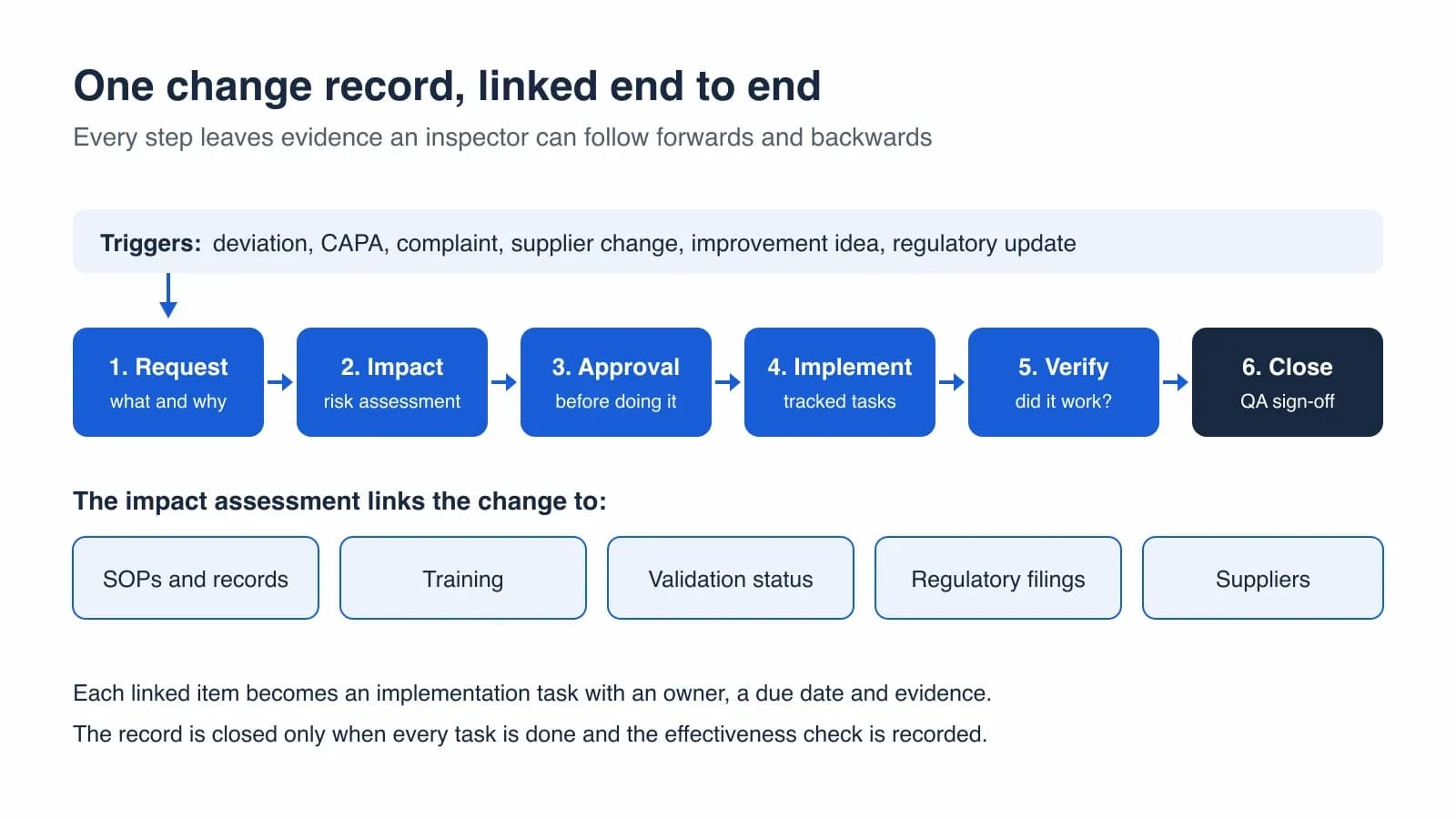
1. Request and rationale
Record what is changing, from what to what, and why. "Improve cleaning" is not a description; "Replace manual cleaning of the granulator bowl with a validated CIP cycle; the current method caused two cleaning deviations this year" is. Link the trigger (deviation, CAPA, complaint, supplier notification or proposal) and state whether the change is permanent or temporary.
2. Classification and impact assessment
This is the core of traceability, and where records are often thinnest. Classify the change (for example minor, major, critical, using criteria defined in your procedure) and then assess impact systematically. A structured checklist works better than free text because it forces a documented answer for each area, including "no impact, because...":
- Product quality and patient safety, including any effect on critical quality attributes or process parameters
- Controlled documents: SOPs, batch records, specifications, methods, forms and labels
- Training: who needs to be trained, on what, and before when
- Validation and qualification status: process, cleaning, equipment, computerised systems, methods
- Calibration and maintenance programmes
- Regulatory status: marketing authorisation, technical documentation or registrations in each market
- Suppliers and contract partners, including quality agreements
- Stability, if the change could affect shelf life
- Product availability and supply continuity
- Other sites, products or lines that share the equipment, material or procedure
The level of formality should follow ICH Q9(R1): a label font change and a new sterilisation cycle should not receive the same depth of analysis, but both should show that someone considered the question. Record who contributed to the assessment, so the multidisciplinary review ICH Q10 expects is visible.
3. Approval before implementation
Approvals are recorded before implementation begins, by the people your procedure defines for that change type, including QA for GMP-relevant changes. If a regulatory approval is needed, the record shows implementation was held until it arrived. Electronic signatures need to meet the requirements that apply to your electronic records, and the approval should be attributable and dated (see our guide to ALCOA+ data integrity).
4. Implementation tasks
Turn every "yes, impacted" answer from the assessment into an action with an owner, a due date and objective evidence of completion: the new document version number, the training completion records, the validation report reference, the supplier's signed agreement. A record that lists actions but holds no evidence for them is exactly the gap inspectors look for.
5. Verification and effectiveness review
Annex 15 section 11.7 and ICH Q10 both expect an evaluation after implementation. Define the success criteria when you approve the change, not afterwards. For the illustrative CIP example above: no cleaning-related deviations over a defined number of batches, and rinse results within limits. Then record the result. If the criteria were not met, the record should show what happened next, typically a deviation, a CAPA or a follow-up change. The same thinking applies to CAPA effectiveness checks.
6. Closure
QA closes the record once every task has evidence and the effectiveness review is complete or formally scheduled. Closure is also the right moment to confirm that the change will appear in the next product quality review.
Linking changes to SOPs, training, CAPAs and deviations
A change record is the hub that connects other quality records. Each link should work both ways.
- SOPs and controlled documents: the change record lists document numbers and new versions; each document's revision history refers back to the change number. This is how an inspector moves from an SOP revision to its justification. Our guide to writing a GMP SOP explains how to keep that revision history useful.
- Training: the record shows that the people affected were trained on the new version before it became effective, not weeks later. A role-based GxP training matrix makes it much easier to identify who is affected.
- CAPAs: many changes are the implementation of a CAPA. The CAPA should reference the change, and the change should reference the CAPA, so the effectiveness review is not done twice or missed entirely.
- Deviations: deviations often reveal changes that happened without approval. When they do, the investigation should lead to a retrospective change assessment and a look at why change control was bypassed. See our article on GMP deviation management.
On paper or in spreadsheets these links are typed reference numbers that are easy to get wrong and rarely checked. In a connected system they are live links, which makes a forwards-and-backwards walk practical during an inspection.
Regulatory notification: when a change is also a filing
The question "does this change need regulatory notification or approval?" should be answered in every change record, even when the answer is no. ICH Q10 3.2.3(b) and EU GMP Chapter 1, section 1.4(xii), both make this explicit.
For medicinal products authorised in the EU, the variations framework applies. Commission Delegated Regulation (EU) 2024/1701 amended the Variations Regulation (EC) No 1234/2008 and has applied since 1 January 2025. According to EMA's guidance on the revised framework, the new Commission variations guidelines, which set out the classification of changes into categories such as Type IA, Type IB and Type II, apply from 15 January 2026. The practical point for change control is that the category determines whether you can implement first and notify afterwards, or must wait for the authority's acceptance or approval before implementing. The change record should name the variation category, reference the submission, and hold implementation until any required approval is granted.
For CE-marked medical devices, the EU Medical Device Regulation requires manufacturers to inform their notified body of any plan for substantial changes to the approved quality management system or the device range it covers (Annex IX, section 2.4). Check the conditions in your notified body agreement too.
Where one person covers both QA and RA, make the regulatory assessment an explicit, separately recorded step.
What inspectors typically find
The following themes recur in GMP inspections because they are the natural failure points of a change control process. They are worth testing in your own self-inspections:
- Changes implemented before approval, or with approval dated after the first use of the new method or equipment.
- Impact assessments that consist of a single sentence, or that skip areas such as validation, stability or regulatory status without justification.
- Changes made outside the system altogether, discovered through a deviation, an equipment logbook or an updated drawing.
- Actions marked complete without evidence, or SOPs made effective before the affected people were trained.
- No effectiveness review, or one that simply restates that the change was implemented.
- Temporary changes that quietly became permanent, with no extension or closure decision on record.
- Regulatory impact not assessed, or a change implemented while a required variation was still pending.
- Change records that cannot be found by product, equipment or document number, so the product quality review misses them.
An illustrative example
This example is illustrative, not taken from any specific company. A small sterile manufacturer must replace a filter used on its filling line because the supplier is discontinuing it. The change record links to the supplier's discontinuation notice as the trigger. The impact assessment, completed by QA, production, validation and regulatory affairs, concludes: the filter specification and incoming inspection SOP need updating; a filter validation study is required; the approved supplier list must be updated and a quality agreement signed; the filter is described in the marketing authorisation dossier, so regulatory affairs concludes a variation is required; and line operators need training on a revised integrity test step.
Each conclusion becomes a task with an owner and evidence: document versions, the validation report, the signed agreement, the variation reference and approval date, and training records dated before the effective date. QA holds implementation until the variation is approved. Effectiveness criteria (no integrity test failures or filter-related deviations over a defined number of batches) are set at approval and reviewed later. When an inspector spots the new filter in a batch record, every step can be shown from one record.
Checklist: is your change record ready for inspection?
- The description states what changes, from what to what, and why, with the trigger linked.
- Every impact area has a documented answer, including "no impact" with a reason.
- The regulatory assessment is explicit and signed by someone qualified to make it.
- All approvals predate implementation.
- Every action has an owner, a due date and evidence attached or referenced.
- Affected people were trained before the new documents became effective.
- Success criteria were set at approval and the effectiveness review is recorded.
- Linked documents, CAPAs and deviations reference the change number in return.
- The record can be found by product, equipment and document number.
Keeping the chain intact
Change control traceability comes down to every decision and action leaving evidence, linked rather than scattered. That is possible on paper, but the cross-referencing tends to break down as volume grows. If you are reviewing your setup, an eQMS such as QFacts handles this in a single change control record: impact assessments across quality, regulatory, safety and operational areas, approval routing by change type and risk level, implementation tasks, and a complete audit trail with electronic signatures, linked to document management and training. You can try it with your own change process during a 7-day free trial on the pricing page.
Sources and further reading
- EudraLex Volume 4, Part I, Chapter 1: Pharmaceutical Quality SystemEuropean Commission
- EudraLex Volume 4, Annex 15: Qualification and ValidationEuropean Commission
- ICH Q10: Pharmaceutical Quality SystemICH
- ICH Q9(R1): Quality Risk ManagementICH
- 21 CFR 211.100: Written procedures; deviationseCFR, U.S. Government
- Quality Management System Regulation (QMSR)U.S. Food and Drug Administration
- Guidance on the application of the revised variations frameworkEuropean Medicines Agency
- ISO 13485:2016 Medical devices: Quality management systemsISO
Try QFacts with your own quality workflow.
Get new articles by email
Practical guidance on quality management and compliance, delivered to your inbox.