Preparing for an FAMHP GMP inspection in Belgium
Who the FAMHP (FAGG/AFMPS) inspects, how EU GMP inspections run, how deficiencies are classified, what happens with GMP certificates in EudraGMDP, and a practical checklist to prepare your site.

In Belgium, GMP inspections are carried out by inspectors of the Federal Agency for Medicines and Health Products (FAMHP), known as FAGG in Dutch and AFMPS in French. They inspect against the EU GMP Guide and follow the harmonised EU procedures for conducting inspections, classifying deficiencies and issuing GMP certificates. Preparing well means being able to show, on any day, that your quality system works: a current site master file, controlled documents, up-to-date training records, deviations, CAPAs and changes under control, and people who can explain their own work.
This guide sets out what the FAMHP publishes about its inspections, what the EU procedures add, and where neither gives a definitive answer. It ends with a practical preparation checklist.
Who the FAMHP inspects
The FAMHP's GMP page states that it is the competent authority in Belgium and that GMP inspections are performed by a team of inspectors from its DG Inspection, Industry Division. Every manufacturer of finished or intermediate medicinal products in the EU, investigational or commercial, for human or veterinary use, must hold a manufacturing authorisation, and those authorised sites are subject to regular inspection.
According to the FAMHP's own Industry Division and Distribution Division pages, inspection work is split broadly as follows:
- Industry Division. Field inspections and administrative checks on the pharmaceutical industry, suppliers of raw materials for industrial and pharmacy preparations, marketing authorisation holders, blood establishments, human body material banks and the medical device industry.
- Distribution Division. Inspections of the distribution channels for medicines and for active pharmaceutical ingredients (Good Distribution Practice), and of advertising for medicines.
In Belgian law, manufacturing and wholesale authorisations are based on Articles 12bis and 12ter of the Law of 25 March 1964 on medicinal products, with detailed rules in the Royal Decree of 14 December 2006. The FAMHP's GDP page notes that the EU GDP guidelines apply to wholesale authorisation holders and to manufacturing authorisation holders that distribute or store medicines.
This article focuses on GMP inspections of manufacturers and importers. Blood establishments, tissue banks and medical device companies have their own legal frameworks and are only touched on here.
Types of inspection
The EU procedure on the conduct of inspections of manufacturers and importers, adopted in May 2023 and in force since 1 January 2024, distinguishes two main types:
- General GMP inspections. Also called routine, periodic or planned inspections. They take place before a manufacturing authorisation is granted, periodically afterwards, after a significant variation to the authorisation, where there is a history of non-compliance, and as follow-up to check corrective actions from a previous inspection. They normally include the QC laboratory.
- Product- or process-related inspections. Focused on a specific product or process, for example before a marketing authorisation is granted, or when complaints and recalls point to a particular product or process step.
How often a site is inspected is risk-based. The EU model for risk-based inspection planning suggests intervals of roughly two to three years for lower-risk sites, one to two years for intermediate sites and less than a year for higher-risk sites, and states that intervals should generally not exceed three years. These are suggested ranges in an EU procedure; the FAMHP does not publish its own site-by-site schedule.
Announced or unannounced?
The EU conduct procedure is clear that competent authorities "have the right to inspect at any time", including during shift work, and that prior announcement "may be given". It explains why advance notice helps: the relevant people and documents can be made available. The EU texts also explicitly provide for unannounced inspections, for example where there are grounds to suspect non-compliance.
We could not find a published FAMHP policy on notice periods for routine GMP inspections. If you have been inspected before, your previous correspondence with the inspectorate is the best guide. Either way, prepare on the assumption that an inspection could start with little or no notice, since the EU texts allow for exactly that.
What happens during the inspection
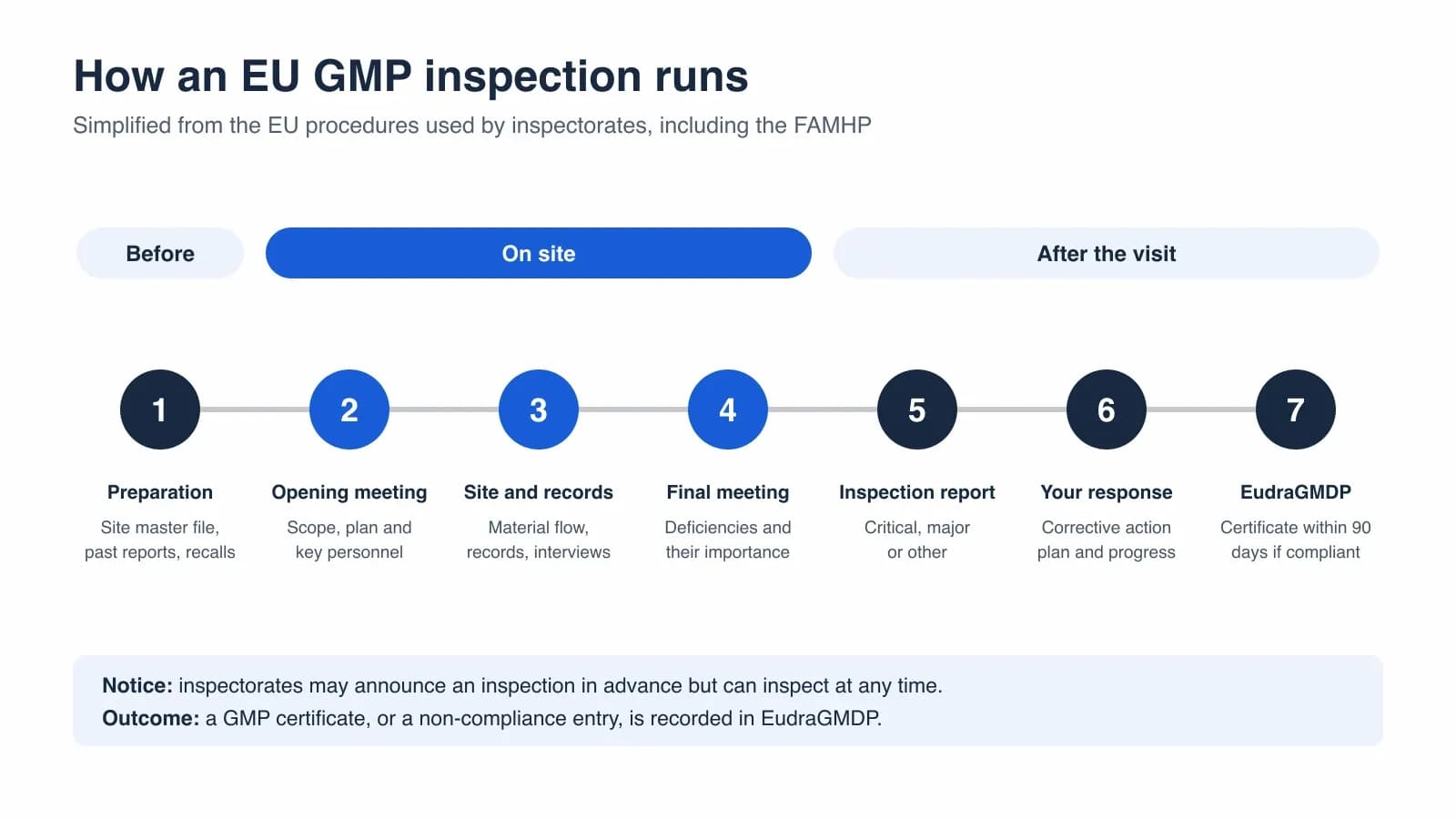
The EU procedure describes the steps most inspectorates follow. Your inspection may differ in detail, but the outline below is a useful guide.
Before the visit
Inspectors familiarise themselves with your site beforehand. The procedure lists, among other things, your site master file, previous inspection reports and follow-up actions, your manufacturing authorisation and variations, recalls and notified product defects since the last inspection, results of samples tested by an Official Medicines Control Laboratory, information in regulatory databases such as EudraGMDP, and significant changes to equipment, processes or key personnel. Assume the inspector arrives knowing your history.
Opening meeting
The procedure says the opening meeting should normally take no more than 30 minutes. The inspector outlines purpose and scope, reviews your organisation chart and identifies documents they may need. You are expected to describe your quality system if asked, explain significant changes since the last inspection, explain how previous deficiencies were resolved, name the people who will accompany the inspector and provide a room.
Site tour and document review
Inspectors often follow the flow of materials from goods receipt through production and QC to the finished goods warehouse, and change their plan if they see signals of a problem. A general inspection normally covers quality management, personnel, premises and equipment, documentation, production, quality control, contract manufacture and analysis, complaints and recalls, and self-inspection. The procedure notes that self-inspection reports themselves should not normally be read, but the self-inspection system will be examined. Inspectors talk to operators and supervisors as they go, partly to assess their knowledge and competence.
Final meeting
At the end, the inspector summarises the findings. The deficiencies and their importance are discussed so that deadlines for remedial action can be set. The company may propose initial corrective actions, and serious deficiencies that put patients at risk can lead to immediate action.
The inspection report and how deficiencies are classified
Reports follow the EU's Union format. The template asks inspectors to list every deficiency with its reference to the EU GMP Guide, including deficiencies that were corrected on the spot. Each deficiency is classified into one of three categories:
- Critical. A deficiency that has produced, or leads to a significant risk of producing, a product that is harmful to the patient.
- Major. A non-critical deficiency that has produced or may produce a product that does not comply with its marketing authorisation, or that indicates a major deviation from GMP or from the manufacturing authorisation, or a failure in batch release or in the Qualified Person's legal duties. Several "other" deficiencies can together amount to a major one.
- Other. A departure from GMP that is not critical or major, either because it is minor or because there is not enough information to classify it higher.
The report concludes whether, within the scope of the inspection, the site operates in general compliance with EU GMP. According to the conduct procedure, the draft report goes to the company for comment so that it can be finalised in time for a GMP certificate to be issued within the statutory 90-day period.
Response timelines
The EU procedures do not set one fixed deadline for a company's response. The report template says the company should be asked to inform the inspectorate of its proposed timetable for corrections and its progress, and the inspectors then comment on whether the responses are acceptable. Deadlines are discussed at the final meeting.
We could not find a published FAMHP rule on how many days a company has to respond to an inspection report. Follow the deadline given in the report or its cover letter, and ask the inspector at the final meeting if it is unclear. A good response, whatever the deadline:
- Addresses every deficiency individually, starting with critical and major ones.
- Explains the root cause, not just the immediate fix, and checks whether the same issue exists elsewhere on site.
- Gives specific corrective and preventive actions with owners and realistic dates.
- Includes evidence for actions already completed.
- Explains how you will check that each action worked. Our guide to CAPA effectiveness checks covers this in depth.
Then deliver what you committed to. Inspectors review follow-up actions from the previous inspection before the next one.
GMP certificates and EudraGMDP
Under Article 111(5) of Directive 2001/83/EC, a GMP certificate must be issued within 90 days of an inspection if the manufacturer complies with GMP. The certificate, or information that the manufacturer does not comply, is entered in EudraGMDP, the EU database of manufacturing, import and wholesale authorisations and GMP and GDP certificates.
The FAMHP announced in 2019 that it adds GMP and GDP certificates to EudraGMDP and no longer issues paper certificates automatically; paper copies are available on request. Only competent authorities can upload certificates, which the FAMHP notes is what guarantees that the information is authentic and valid.
According to the EU procedure on GMP certificates, a certificate reflects the site's status at the time of inspection and should not be relied on if more than three years have passed since that inspection, unless the issuing authority extends it. An authority can also limit a certificate to a shorter validity. Check your own entry in the public EudraGMDP database after each inspection, since customers and business partners can look it up too.
Belgian points worth preparing for
The FAMHP's production FAQ (published in Dutch and French) contains expectations about the Qualified Person that inspectors can easily check:
- The QP is expected to be physically present at the company at least once a week, whatever their contract. Less frequent presence must be justified and its risks managed.
- A presence register showing the QP's physical presence and its duration, signed by the QP, should exist.
- The batch certification register must contain specific items for each certified batch, be completed as work progresses, and show certification before the batch moves to saleable stock.
- An electronic certification register is acceptable if it is a validated system in line with EU GMP Annex 11 and the QP signs it with a legally valid signature.
- Where a company has several QPs, the list and every change to it must be sent to the FAMHP, and a QP who wants to work for more than one authorisation holder must apply to the FAMHP first.
The FAMHP asks for GMP questions to be sent to industry@fagg-afmps.be with "GMP" in the subject line.
Preparation checklist
Most of this checklist is good practice drawn from the EU procedures above rather than a published FAMHP requirement.
Documents and records
- Site master file. Current, consistent with reality and reviewed on schedule. The EU explanatory notes on the site master file suggest it should, as far as possible, not exceed 25 to 30 pages plus appendices.
- SOP index. A list of all controlled documents with current version and effective date, no overdue periodic reviews and no uncontrolled copies on the shop floor. See our guide on writing GMP SOPs.
- Training records. Every person who performs GMP tasks, including contractors, cleaning and maintenance staff, trained on the current version before doing the work. Our article on building a GxP training matrix covers what inspectors ask for.
- Deviations, CAPAs and change controls. A current list of open items, with ageing and justification for anything overdue. Inspectors commonly sample recent deviations and follow them into CAPA and change control; see GMP deviation management.
- Previous inspection commitments. Every action closed with evidence, or a documented reason for delay.
- Quality system outputs. Product quality reviews, management review, self-inspection programme, complaints, recalls and quality defect handling.
- Contracts. Quality agreements with every contract manufacturer and laboratory.
- Data integrity. Audit trail reviews performed and documented for GMP computerised systems.
- QP records. Certification register and presence register, complete and current.
People and logistics
- Inspection host. One person who leads, sets the tone and is the inspector's main contact.
- Front room. Where the inspector works, staffed by the host and a scribe who records every question, request and commitment.
- Back room. A team that retrieves documents, checks them before they go to the front room, logs every document handed over, and prepares subject matter experts.
- Subject matter experts. Named people for each area, briefed to answer the question asked, say when they do not know and offer to find out, and never speculate.
- Escorts and readiness. Escorts for the site tour, gowning arranged, and areas in a state you are happy to show at any time.
- Daily debrief. A short internal meeting each evening to review requests, open questions and likely findings.
The front room and back room set-up is common industry practice, not a regulatory requirement. In a small company the same few people may cover several of these roles.
Keeping the evidence in one place
Inspection readiness depends on finding the right record quickly and showing how documents, training, deviations, CAPAs and changes connect. QFacts is a Belgian eQMS that keeps these records together, can generate audit evidence packages, and lets you track inspection findings through to closure with CAPAs and regulatory compliance tools. It supports your preparation; the inspection outcome still depends on how your quality system works in practice. You can try it with the 14-day free trial on the pricing page.
Sources and further reading
- GMP of Good Manufacturing PracticesFederal Agency for Medicines and Health Products (FAMHP)
- Industry DivisionFederal Agency for Medicines and Health Products (FAMHP)
- GMP and GDP certificates no longer on paperFederal Agency for Medicines and Health Products (FAMHP)
- Productie: FAQ's (questions on the Qualified Person and certification register)Federal Agency for Medicines and Health Products (FAMHP)
- Conduct of inspections of pharmaceutical manufacturers or importersEuropean Commission / European Medicines Agency
- Compilation of Union procedures on inspections and exchange of information (including the Union format GMP inspection report)European Medicines Agency
- The issue and update of good manufacturing practice (GMP) certificatesEuropean Commission / European Medicines Agency
- A model for risk based planning for inspections of pharmaceutical manufacturersEuropean Commission / European Medicines Agency
Try QFacts with your own quality workflow.
Get new articles by email
Practical guidance on quality management and compliance, delivered to your inbox.