
ISO 9001:2026: what changes for your quality management system
ISO 9001:2026 was published on 16 September 2026, with a transition deadline of 30 September 2029. Here is what was revised, what stayed the same, and what it means for your documents, management review and internal audits, with a transition checklist.

ISO 9001:2026 was published on 16 September 2026 and replaces ISO 9001:2015, including its 2024 climate amendment. It is an evolution, not a rewrite: the clause structure, process approach and risk-based thinking stay. The changes that matter in practice are an explicit requirement for top management to promote quality culture and ethical behaviour, a clearer split between risks and opportunities, firmer expectations for planning changes to the quality management system (QMS), and a much larger informative Annex A. Certified organisations have until 30 September 2029 to transition, and from 31 March 2028 new certifications can only be issued to the 2026 edition.
This article sets out what was revised, what was not, and what the changes mean for your documented information, management review and internal audits. It ends with a transition checklist you can adapt.
The short version
ISO describes the sixth edition as a targeted update focused on clarity and usability, with more emphasis on leadership, quality culture and accountability, clearer handling of risks and opportunities, a new Annex A and closer alignment with other ISO management system standards (ISO). BSI calls it a natural evolution and says existing systems need refining rather than redesigning (BSI).
If your QMS works well under ISO 9001:2015, you will not need to rebuild it. You will need to show how leadership promotes quality culture and ethical behaviour, review how you handle risks and opportunities, check your change process, and update documents and training to match the new clause wording.
Key dates and the transition period
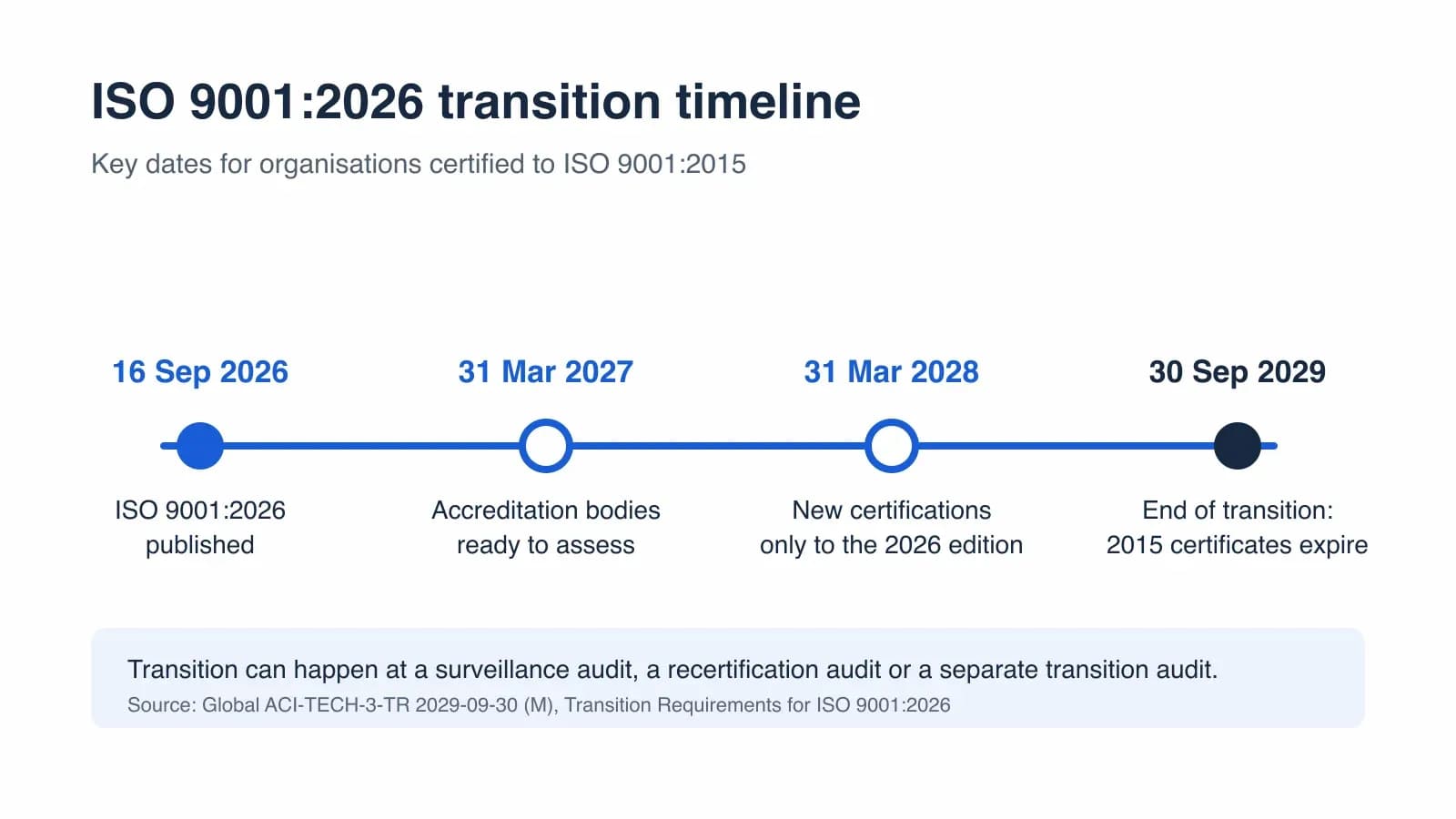
ISO does not set transition deadlines. The accreditation community does. Global ACI, the body that now issues these mandatory transition requirements, published its document Global ACI-TECH-3-TR 2029-09-30 (M) on the same day as the standard (Global ACI). The dates that affect certified organisations are:
- 16 September 2026: ISO 9001:2026 published. The three-year transition starts.
- 31 March 2027: accreditation bodies must be ready to assess against the new edition. Certification bodies then need their own accreditation for the new edition before they can issue accredited ISO 9001:2026 certificates.
- 31 March 2028: new and initial accredited certifications can only be issued to ISO 9001:2026.
- 30 September 2029: organisations certified to ISO 9001:2015 must have completed their transition. DNV notes that 2015 certificates are no longer valid after this date (DNV).
The transition can take place at a scheduled surveillance audit, at a recertification audit or through a separate transition audit. Your ISO 9001:2015 certificate remains valid during the transition.
A practical point: if your recertification falls in 2027 or 2028, aligning the transition with it usually avoids a separate audit. Ask your certification body early when it expects accreditation for the new edition, because you cannot be audited against ISO 9001:2026 for an accredited certificate before then.
What changed, clause by clause
The summary below draws on certification bodies that have compared the editions. Buy and read the published text before you change procedures. Clause numbering and exact wording matter when an auditor raises a finding.
Clause 3: core terms now in the standard
The 2015 edition defined its terms only by reference to ISO 9000. The 2026 edition still refers to ISO 9000, but it also lists the core terms from ISO's harmonised structure for management system standards directly in clause 3 (DNV, LRQA). If your quality manual or glossary quotes definitions, check them against the new list.
Clauses 4.1 and 4.2: climate change carried over
In 2024, an amendment to ISO 9001:2015 required organisations to determine whether climate change is a relevant issue and noted that interested parties can have climate-related requirements. The 2026 edition integrates that amendment into clauses 4.1 and 4.2 (DNV). If you already addressed the 2024 amendment, this is not new work. If you did not, your context analysis should record whether climate change is relevant to your QMS and why.
Clauses 5.1.1, 7.1.4 and 7.3: quality culture and ethical behaviour
This is the change most organisations will notice. Clause 5.1.1 adds promoting quality culture and ethical behaviour to top management's leadership commitments. Quality culture and ethical behaviour are also referenced in clause 7.1.4 (environment for the operation of processes) and clause 7.3 (awareness) (DNV). In other words, leaders must promote them, the working environment must support them, and people must be aware of them.
The standard does not prescribe a culture survey, an ethics policy or any particular document. What auditors will look for is evidence that leadership acts on this: how concerns can be raised, how quality and ethical issues reach management, how decisions balance output against quality, and whether staff can describe what is expected of them.
Clause 6.1: risks and opportunities separated
In the 2015 edition, risks and opportunities were handled together. The 2026 edition separates them into subclauses 6.1.1 to 6.1.3, with expanded guidance in Annex A (DNV). Perry Johnson Registrars' review of the final draft describes 6.1.2 as covering actions to address risks and 6.1.3 as covering opportunities, with parallel wording (PJR).
Many registers list a column of risks with an "opportunities" field that is rarely filled in. Under the new structure, expect auditors to ask how you identify opportunities and what you decided to do about them.
Clause 6.3: planning changes to the QMS
Clause 6.3 has been reinforced so that changes to the QMS are planned, communicated, monitored and reviewed (LRQA, BSI). This concerns changes to the system itself, such as a reorganisation, a new site, a merged procedure set or a new eQMS. It is separate from control of changes to products and processes under clause 8.
Illustrative example: a company moving its procedures from a file share into an eQMS would plan the move, decide who needs to be told and trained, set checks to confirm that controlled documents and records transferred completely, and review the result afterwards. Under the 2026 wording, auditors are more likely to ask for that trail. Our guide to moving from paper to an eQMS covers that kind of change in detail.
Clause 10: improvement consolidated
DNV reports that a new clause 10.1 on continual improvement mainly consolidates requirements from the former 10.1 and 10.3, and that Annex A notes improvement can come from changes in context, risks, opportunities and technology (DNV). Check your cross-reference tables, because clause numbers in this area have moved.
Annex A: guidance, not new requirements
Annex A has been substantially expanded to explain the structure, terminology and intent of the requirements. It is informative and does not add obligations (LRQA). It is still worth reading closely, because it shows how the committee intended clauses such as 6.1 to be read. Auditors may refer to it when explaining a finding, but a nonconformity has to be raised against a requirement, and Annex A contains none.
What has not changed
The process approach, the plan-do-check-act cycle and risk-based thinking remain central, and the revision makes targeted updates rather than restructuring the standard (LRQA). BSI states that the core requirements for monitoring, measurement, internal audits and management review continue as before, and that the operational requirements in clause 8 mainly see terminology updates (BSI).
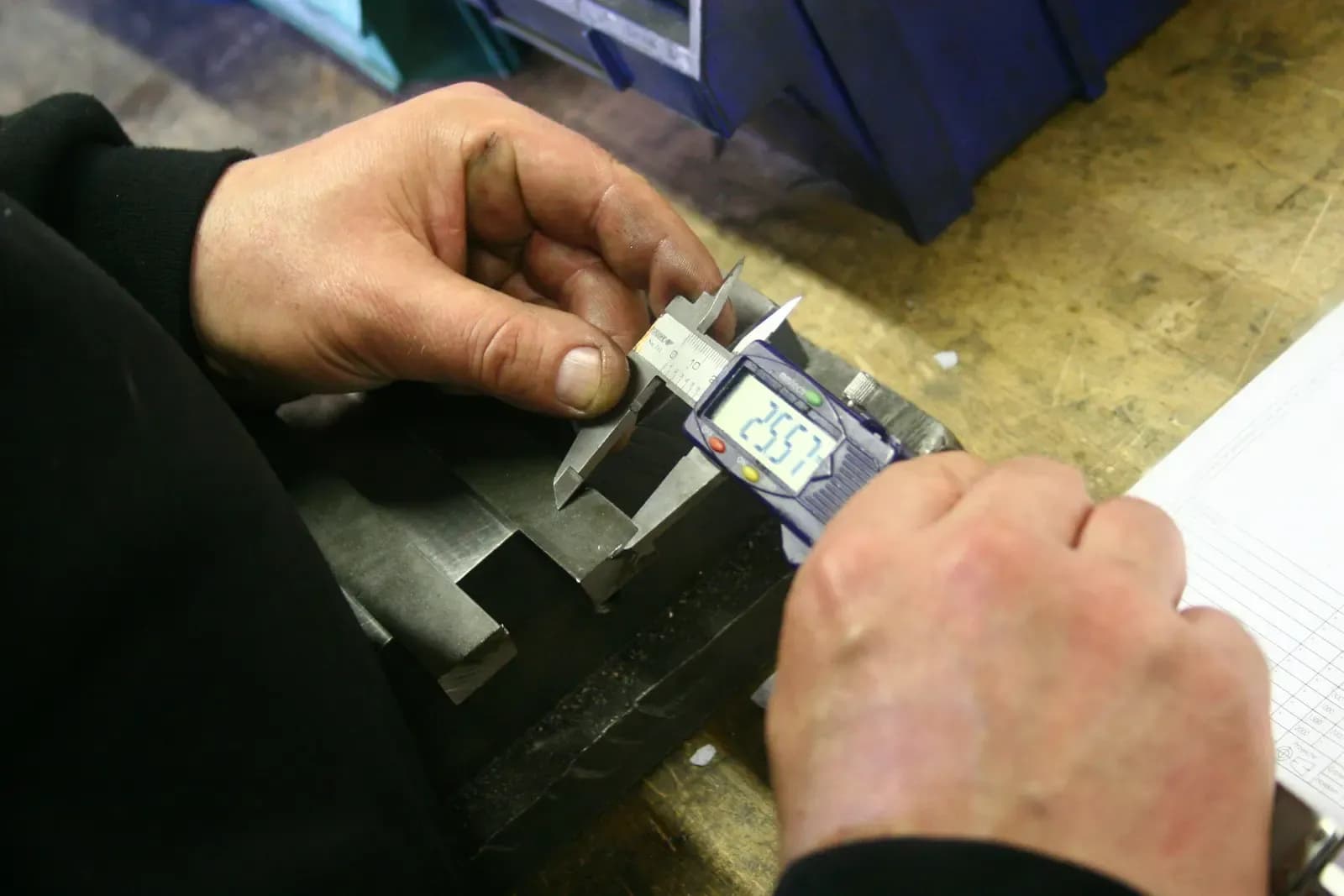
For most organisations, the day-to-day controls of design, purchasing, production, inspection, nonconforming output and corrective action will not need to change because of the new edition.
What it means for documented information
The new edition does not ask for a new set of mandatory procedures. The changes for documented information are about alignment and wording:
- Clause references. Quality manuals, procedure headers, audit checklists and cross-reference tables that cite clause numbers will need updating, particularly around 6.1 and clause 10.
- New topics to evidence. You should be able to show how you address quality culture and ethical behaviour, how you treat opportunities separately from risks, and how you plan changes to the QMS. That may mean updating an existing procedure rather than writing a new one.
- Wording on documents and records. PJR's review of the final draft notes that the 2015 distinction between "maintaining" and "retaining" documented information is replaced by wording that makes documented information available, with "available as evidence" indicating a record (PJR). Confirm this against the published text before rewording your procedures. Changed wording does not mean you can discard records.
Run each change through your normal document review and approval cycle, with version history, so the transition itself leaves a clear trail. If you manage controlled documents in an eQMS, this is a good time to check that review dates, approvers and superseded versions are in order. See how document management handles review and approval.
What it means for management review
The management review requirements remain broadly the same, so you do not need a new agenda. You do need to make sure the review covers the new topics. A practical approach is to add three items to your next review and minute the decisions:
- The results of your gap assessment against ISO 9001:2026, with the transition plan, owners and target audit date.
- How leadership promotes quality culture and ethical behaviour, and what indicators it uses (for example, how often near misses or concerns are reported, or how quickly quality issues are escalated). These are illustrative indicators; choose ones that fit your organisation.
- The separate review of risks and of opportunities, and the effectiveness of the actions taken on each.
Management review is also where top management can show the commitment that clause 5.1.1 now names explicitly. A review where leaders make and record decisions is stronger evidence than a slide pack presented to them.
What it means for internal audits
Internal audit requirements are not substantially changed (BSI), but your audit programme should change before your transition audit:
- Update audit checklists to the 2026 clause numbering and wording.
- Brief internal auditors on the new requirements. Auditing quality culture is different from auditing a procedure: it relies more on interviews and on following decisions through records.
- Schedule at least one internal audit covering clauses 5.1.1, 6.1, 6.3, 7.1.4 and 7.3 before the certification body arrives, and close any findings through your corrective action process.
What auditors are likely to look for
Based on the changed clauses, expect a transition auditor to:
- Ask top management, not only the quality manager, how they promote quality culture and ethical behaviour, and look for examples in records.
- Ask employees what quality culture and ethical behaviour mean in their work, as part of awareness under clause 7.3.
- Compare your risk and opportunity records with the new 6.1 structure and look for actions on opportunities, not only risks.
- Sample a recent change to the QMS and follow it from planning through communication to review.
- Check that your climate change decision under clause 4.1 is recorded and reasoned.
- Check that your documentation refers to the current edition.
Common pitfalls
- Treating culture as a poster. A values statement on the wall does not show that leaders promote quality culture. Evidence comes from decisions, communication and how issues are handled.
- Renaming instead of reviewing. Adding an "opportunities" heading to an unchanged risk register will not show that you identify and act on opportunities.
- Waiting for the deadline. Transition audits will cluster as 2029 approaches. Booking late risks a gap in certification if the audit slips or findings remain open.
- Rewriting everything. The changes are targeted. Large rewrites create training load and new errors without adding conformity.
- Working from a draft. Several early summaries were written against the draft or final draft. Use the published standard as your reference.
A transition checklist
- Buy the published ISO 9001:2026 and give the relevant people access to it.
- Confirm with your certification body when it expects accreditation for the new edition and when your transition audit can take place.
- Run a gap assessment against the changed clauses: 3, 4.1, 4.2, 5.1.1, 6.1, 6.3, 7.1.4, 7.3 and clause 10.
- Record your climate change decision in your context analysis if you have not already done so.
- Agree with top management how quality culture and ethical behaviour will be promoted and evidenced.
- Restructure your risk and opportunity process to match 6.1 and review the actions for each.
- Check that your process for planning QMS changes covers communication, monitoring and review of the change.
- Update the quality manual, procedures, forms and cross-reference tables through document control.
- Update awareness training and induction to cover quality culture and ethical behaviour, and record completion.
- Update internal audit checklists and audit the changed clauses.
- Cover the transition in a management review and record the decisions.
- Close internal findings through corrective action, then hold the transition audit.
For step 9, it helps to link the updated documents to the roles that must be trained on them. Our article on building a GxP training matrix explains one way to do that, and training management shows how assignments can follow document changes.
A note for life-science companies
Many pharmaceutical, biotech and medical device organisations hold ISO 9001 for a site, a service or a supplier relationship, while medical device manufacturers usually certify to ISO 13485. ISO 13485:2016 is a separate standard and has not changed because ISO 9001 did. If you are a device maker selling into the United States, the more pressing change this year was the FDA's Quality Management System Regulation, which incorporates ISO 13485 by reference; see what QMSR alignment means for device makers.
If you are planning the transition in an eQMS, QFacts keeps documents, training, CAPAs and change control in one place, which helps you show how a change to the QMS was planned, communicated and checked. You can try it with a 7-day free trial.
Sources and further reading
- ISO 9001:2026 Quality management systems — RequirementsInternational Organization for Standardization (ISO)
- Global ACI publishes transition requirements for ISO 9001:2026Global Accreditation Cooperation Incorporated (Global ACI)
- ISO 9001:2026 standard revisionDNV
- BS EN ISO 9001:2026 is here: celebrating 30 years of quality managementBSI
- ISO 9001:2026 key changes and guidanceBSI
- ISO 9001 revision: FDIS updateLRQA
- ISO 9001:2026: what's changed (not much), and what has stayed the same (a lot)Perry Johnson Registrars
Try QFacts with your own quality workflow.
Get new articles by email
Practical guidance on quality management and compliance, delivered to your inbox.