EU GMP Annex 11 revision: what the draft changes for computerised systems
The revised EU GMP Annex 11 is still a draft as of October 2026. Learn where the revision stands, what the July 2025 draft changes for audit trails, e-signatures, access, suppliers and periodic review, and what to do now.

As of early October 2026, the revised EU GMP Annex 11 is still a draft. The European Commission published the draft on 7 July 2025, together with a revised Chapter 4 (Documentation) and a new Annex 22 on artificial intelligence. The consultation closed on 7 October 2025. EudraLex Volume 4 still lists the January 2011 version of Annex 11, so that is the text inspectors apply today. The European Medicines Agency's inspectors working group is aiming to hand the European Commission a final text in the fourth quarter of 2026. The draft is far more detailed than the current annex. It grows from about five pages to 19 and adds specific expectations on audit trails, electronic signatures, identity and access management, periodic review, suppliers and cloud services, security and backup.
This article summarises where the revision stands, what the draft would change, and what a small or mid-sized company can sensibly do before the final text arrives.
Where the revision stands
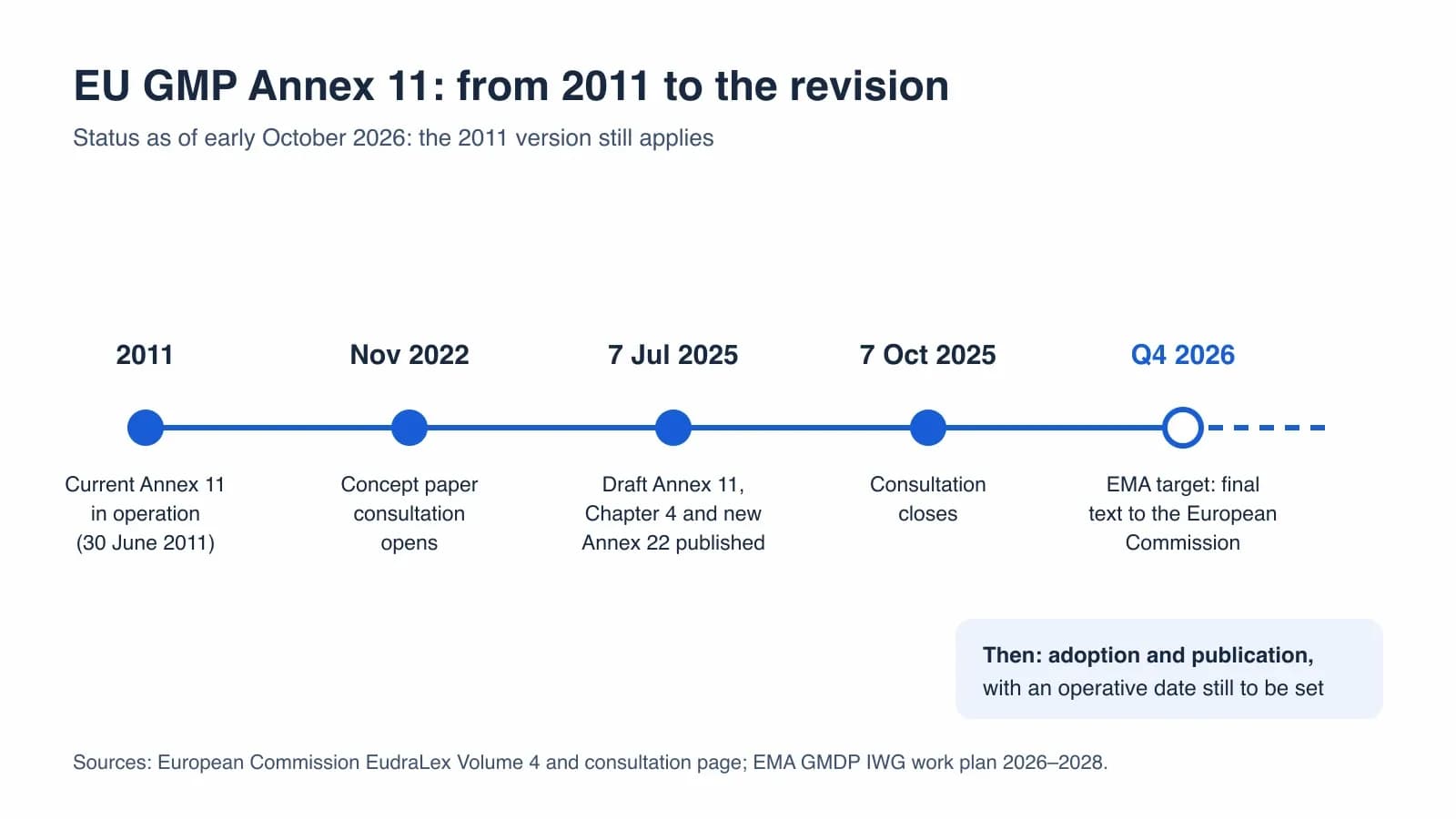
The key dates, from primary sources:
- 30 June 2011. The current Annex 11 came into operation.
- 16 November 2022 to 16 January 2023. EMA and PIC/S consulted on a concept paper explaining why Annex 11 needed revising. It cited new technologies, cloud services, agile development and data integrity.
- 7 July 2025. The Commission opened a stakeholder consultation on the draft Annex 11, Chapter 4 and Annex 22. The texts were developed by the EMA GMP/GDP Inspectors Working Group in cooperation with PIC/S.
- 7 October 2025. The consultation closed.
- 23 March 2026. EMA published the working group's three-year work plan for 2026 to 2028. It sets a Q4 2026 target for providing the Commission with final texts of Annex 11, Chapter 4 and Annex 22, and plans inspector training on the revised texts during 2026 to 2028.
Two cautions. First, a target for handing over a final text is not a publication date. The Commission still has to adopt and publish it, and the date it comes into operation, along with any transition period, will be set then. Second, the final text may differ from the draft. Industry bodies such as ISPE submitted detailed comments, some of them objecting to specific clauses. Plan for the direction of travel, not for the exact wording.
Annex 11 is common to the EU and to the participating authorities of PIC/S. The concept paper states that the revised text will also replace the PIC/S version of Annex 11, which matters if you supply markets outside the EU.
What the draft changes at a glance
The 2011 annex has 17 short sections. The draft has 17 longer ones: scope, principles, pharmaceutical quality system, risk management, personnel and training, system requirements, supplier and service management, alarms, qualification and validation, handling of data, identity and access management, audit trails, electronic signatures, periodic review, security, backup and archiving.
The shift in tone is more important than the structure. The current annex mostly says what should be considered. The draft says what systems should do, often in testable terms. Many expectations that inspectors already raise under data integrity guidance are written into the annex itself.
The main changes in detail
Principles, quality system and risk
The draft explicitly ties data integrity to ALCOA+ and requires quality risk management in every lifecycle phase. It states that when activities are outsourced, the regulated user stays fully responsible and must hold the evidence. It also requires the pharmaceutical quality system to cover computerised systems explicitly: deviations investigated with CAPAs whose effectiveness is verified, changes under change control, internal audits, management review of system performance and senior management oversight. If you run change control and CAPAs only for products and processes, extend them to systems.
System requirements
Section 6 expects an approved set of system requirements, such as a user requirements specification, for every system. This applies whether the system is built in-house, bought off the shelf or used as a service. A vendor may provide the specification, but you should review it, approve it and take ownership of the version that describes your implemented system. Requirements must be kept up to date, traced to tests, and accompanied by a controlled configuration specification.
Supplier and service management
This is the section most relevant to companies using cloud software. Under the draft, relying on a vendor's or service provider's qualification does not reduce your responsibility. You should audit or thoroughly assess the provider according to risk, oversee them through agreed service levels and KPIs, and be able to explain their documentation from your own site. The contract should cover, among other things:
- what activities and documentation the provider delivers
- reporting, response and resolution times
- conditions for supplier audits and support during inspections
- how quality and security issues are communicated
- an exit strategy that lets you keep control of your data
- how new versions are released, and your possibility to test them before release
Qualification and validation
The draft points to Annex 15 for general validation principles. It expects test cases to be traceable to requirements, and evidence in the form of executed test scripts and, where relevant, screen dumps. Testing should focus on access privileges, calculations, audit trails, error handling, alarms, boundary and negative tests, interfaces and restore from backup. Vendor documentation may be used, but the regulated user remains accountable for it. Conditional release with open deviations is allowed only with a documented assessment showing no impact on quality, safety or data integrity.
This is where the draft sits uneasily with FDA's computer software assurance approach, which accepts unscripted testing for lower-risk functions. In its consultation comments, ISPE argued that requiring pre-approved test scripts would rule out unscripted and automated testing. Our article on CSA vs CSV explains the FDA position.
Identity and access management
Section 11 is one of the most concrete in the draft:
- unique personal accounts, with shared accounts allowed only for read-only access
- authentication strong enough to identify users with a high degree of certainty, and multifactor authentication for remote access to critical systems from outside controlled perimeters
- account lock after repeated failed log-ins, and automatic logout after inactivity
- an access log showing who logged in, in which role, and when they logged in and out
- segregation of duties, so that users involved in GMP activities do not hold administrator privileges
- least privilege, and documented recurring access reviews by managers
The segregation of duties point deserves attention in small companies, where the quality manager is often also the system administrator. If you cannot separate the roles, the draft allows alternative practices that are "proven and documented" to give the same or higher level of control (section 2.3). Expect to justify that.
Audit trails
The draft turns the 2011 instruction to consider an audit trail, based on risk, into a set of requirements. Systems where users create, modify or delete data, settings or access rights should log all manual user interactions, capturing who, what (old and new value), when and why. The reason for a change should be prompted by the system. Audit trails should be always on, locked and not editable. It should be possible to search and sort them, or export them to a tool that can.
Audit trail review becomes a defined process. It should follow a documented procedure, be carried out by someone not involved in the activity, focus on risk rather than every entry, and be completed before batch release unless later review is justified. It should also be possible to obtain a complete electronic copy of data including audit trails. The draft says flat, locked files are not acceptable. Our guide to ALCOA+ data integrity covers the review side in more depth.
Electronic signatures
The 2011 text makes three short points about electronic signatures. The draft asks for:
- full re-authentication when signing, with a simplified password or biometric step for signatures in immediate sequence
- the meaning of the signature, such as review or approval
- a displayed manifestation with full name, username, role where applicable, meaning, date and time
- a permanent link to the record, so that a signed record cannot be changed or clearly shows as unsigned after a change
- for hybrid wet-ink signing of electronic records, a mechanism such as a printed checksum
Periodic review
The 2011 annex asks for periodic evaluation in one paragraph. The draft lists what a review should cover. The list includes changes to the system and its documentation, the combined effect of multiple changes, open CAPAs and audit findings, audit trail and access reviews, incidents and security threats, supplier SLAs and KPIs, backup and restore tests, archiving, data integrity assessments and regulatory changes. Review frequency should be justified by risk, and a final review is expected when a system is retired.
Security, backup and archiving

Sections 15 to 17 read like an information security baseline. They cover an information security management system, timely patching of supported platforms, isolation of unsupported or unpatched ones, firewall reviews, control of USB devices, anti-virus, and regular penetration testing of internet-facing critical systems. They also cover replication to a distant secondary data centre where relevant, tested disaster recovery with a defined recovery time objective, and backups that are physically and logically separated from the original data and tested by restoring them. Archived data should be read-only, verified when moved (for example by checksum) and retrievable in a searchable format. For SaaS users, most of this is delivered by the provider, which is why the supplier section matters so much.
The companion texts: Chapter 4 and Annex 22
The revised Chapter 4 introduces data governance systems, risk-based documentation controls and a dedicated section on hybrid paper and electronic systems. It is meant to be read alongside Annex 11.
The new Annex 22 applies to AI models used in critical GMP applications with direct impact on patient safety, product quality or data integrity. As drafted, it covers only static models with deterministic outputs. It says dynamic models, and generative AI and large language models, should not be used in critical GMP applications. Where generative AI is used in non-critical applications, qualified people should check that the outputs are suitable. EMA scheduled a multistakeholder workshop on expert contributions to Annex 22 for 30 June to 1 July 2026, which suggests this text in particular is still developing.
What to do now
You do not need to rebuild your validation framework around a draft. You do need to avoid a scramble when the final text lands with a fixed operative date. A proportionate plan for a small or mid-sized company:
- Keep complying with the 2011 Annex 11. It is the text in force, and inspection findings will be raised against it and against existing data integrity guidance.
- Update your system inventory. List every computerised system used in GMP activities, its GMP functions, its owner and whether it is on-premise or a service.
- Run a light gap assessment against the draft. Focus on sections 7, 11, 12, 13 and 14. Each builds on a topic already present in the 2011 text, so work on them is unlikely to be wasted. Record the gaps as actions with owners rather than fixing everything immediately.
- Review supplier agreements. Check exit strategy, release notification and pre-release testing, audit rights and inspection support against the draft's contract list. Raise gaps at the next renewal.
- Look at admin rights. Identify where GMP users also hold administrator privileges, and decide whether to separate the roles or document a justified alternative.
- Write or update an audit trail review procedure. Define who reviews what, when and how, per system.
- Strengthen periodic review. Turn the draft's list into a periodic review template now. It is good practice whatever the final wording.
- Watch for publication. Check EudraLex Volume 4 for the final text and its operative date, then plan the remaining work against that date.
A regulatory compliance register that maps each draft requirement to an owner and an action makes step 3 easier to track and report.
Common pitfalls
- Treating the draft as law. Citing draft clauses in SOPs as requirements can create self-imposed findings. Reference them as good practice until the final text is published.
- Assuming the vendor covers it. For SaaS, the provider can supply much of the evidence. But under both the current and draft texts, you remain responsible and must be able to explain it.
- Forgetting configuration. Vendor validation covers the standard product. Your roles, workflows and templates are yours to specify and verify.
- Reviewing every audit trail entry. The draft calls for risk-targeted review. Reviewing everything usually means nothing is reviewed well.
- Waiting for the final text before doing anything. Renegotiating supplier contracts and changing access models can take months.
What inspectors look for
Under the current annex, inspectors typically ask for the system inventory, risk-based validation evidence, supplier assessments, change control for system changes, access management records, audit trail review practice and periodic evaluations. In Belgium, the FAMHP inspects against the EU GMP guide. Our article on preparing for a FAMHP GMP inspection covers what to expect. The draft does not invent these topics. It makes them explicit, which means fewer grey areas and less room for "we considered it" answers.
Next step
Start with the inventory and a one-page gap assessment for your most critical system. If you are choosing an eQMS at the same time, check how it handles audit trails, electronic signatures, role-based access and periodic review of documents. QFacts is one option to evaluate: it records who did what and when on controlled documents and quality records, supports configurable approval workflows with electronic signatures, and lets you map Annex 11 requirements to controls and actions. You can try it with the 14-day free trial.
Sources and further reading
- Stakeholders' consultation on EudraLex Volume 4: Chapter 4, Annex 11 and new Annex 22European Commission
- Draft Annex 11: Computerised Systems (consultation version, July 2025)European Commission
- EudraLex Volume 4, Annex 11: Computerised Systems (2011)European Commission
- EudraLex Volume 4: Good Manufacturing Practice guidelinesEuropean Commission
- 3-year work plan for the GMDP Inspectors Working Group (2026 to 2028)European Medicines Agency
- Concept paper on the revision of Annex 11 (EMA/INS/GMP/778340/2022)European Medicines Agency and PIC/S
- Draft Annex 22: Artificial Intelligence (consultation version, July 2025)European Commission
- ISPE comments on the draft Annex 11 Computerised Systems (7 October 2025)ISPE
Try QFacts with your own quality workflow.
Get new articles by email
Practical guidance on quality management and compliance, delivered to your inbox.