ALCOA+ explained: data integrity principles with practical examples
What ALCOA, ALCOA+ and ALCOA++ mean, with paper and electronic examples for each principle, the data integrity failures inspectors find most often, audit trail review expectations and a self-check list.

ALCOA+ is a set of attributes that GxP records must have to be trusted: Attributable, Legible, Contemporaneous, Original and Accurate (ALCOA), plus Complete, Consistent, Enduring and Available (the "+"). ALCOA++ adds Traceable. The attributes apply equally to a handwritten logbook entry and to a value stored in a database. In everyday terms, each record should show who did what and when, in a form that cannot be quietly changed, and stay retrievable for as long as you must keep it.
This article explains where the terms come from, what each attribute means in practice with paper and electronic examples, the failures inspectors find most often, what regulators expect from audit trail review, and a self-check list you can use this week.
Where ALCOA, ALCOA+ and ALCOA++ come from
Several regulators use the acronym, with small differences in wording but not in substance:
- FDA's Data Integrity and Compliance With Drug CGMP Q&A (December 2018) describes complete, consistent and accurate data as attributable, legible, contemporaneously recorded, original or a true copy, and accurate (ALCOA).
- The MHRA GxP Data Integrity Guidance and Definitions (March 2018) uses ALCOA. It states that there is no difference in expectations whichever acronym you use, because data governance should in any case ensure data are complete, consistent, enduring and available.
- PIC/S PI 041-1 (July 2021) and WHO TRS 1033, Annex 4 (2021) both use ALCOA+ explicitly. They apply it to paper, electronic and hybrid systems.
- EMA's Guideline on computerised systems and electronic data in clinical trials (2023) uses ALCOA++, adding traceable: changes to data and metadata should be traceable and should not obscure the original information.
- The European Commission's draft revision of EU GMP Chapter 4, published for consultation in July 2025, also uses ALCOA++ in its data integrity table and glossary. Check the EudraLex pages for its final status before citing it as adopted.
For a quality team, the practical message is the same whichever version applies to you. Build your records so that they meet all ten attributes.
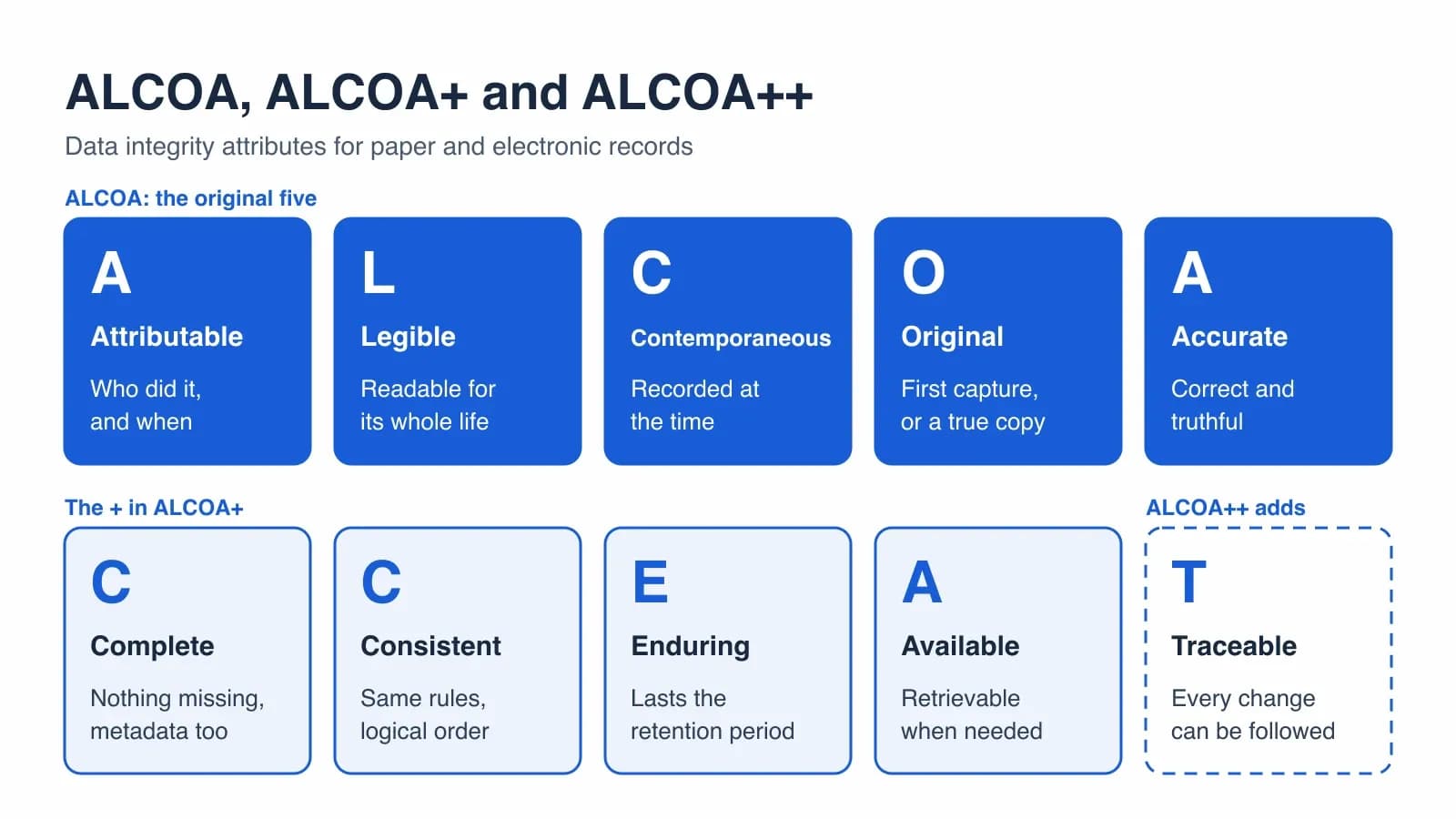
The principles, with paper and electronic examples
The examples below are illustrative. They show common patterns, not specific companies.
Attributable
You can identify who performed an action and when, including who made each change and why. PIC/S PI 041-1 applies this to corrections and deletions as well as original entries.
- Paper: each entry is initialled and dated by the person who did the work. A signature list maps initials to names.
- Electronic: every user has a personal account. The system records the user and timestamp for each entry and change.
Legible
Records can be read and understood for their whole life. For electronic data, the EMA guideline adds that changes such as compression or encryption should be fully reversible, so the data can still be reviewed in their original context.
- Paper: entries in indelible ink, never pencil or correction fluid. Corrections are a single line through the original entry so it stays readable, with a signature and date. EU GMP Chapter 4 (sections 4.7 and 4.9) requires handwritten entries to be clear, legible and indelible, and alterations to leave the original readable. PIC/S PI 041-1 asks inspectors to check that pencil was not used.
- Electronic: data can be displayed in a human-readable form, including the audit trail.
Contemporaneous
The record is made at the time of the activity, not reconstructed later. EU GMP Chapter 4 (section 4.8) requires records to be made or completed at the time each action is taken.
- Paper: the operator writes the result in the batch record at the bench, not on a glove or a sticky note to copy later.
- Electronic: the system timestamps entries from a controlled clock that users cannot change.
Original
The original is the first capture of the information, or a verified true copy of it. PIC/S notes that data first captured in a dynamic electronic form should stay available in that form.
- Paper: the signed page in a controlled, paginated logbook is the original. A typed-up summary is not.
- Electronic: the raw data file from an instrument, with its metadata, is the original. A printout of a chromatogram is not a full replacement if it loses the ability to reprocess the data.
Accurate
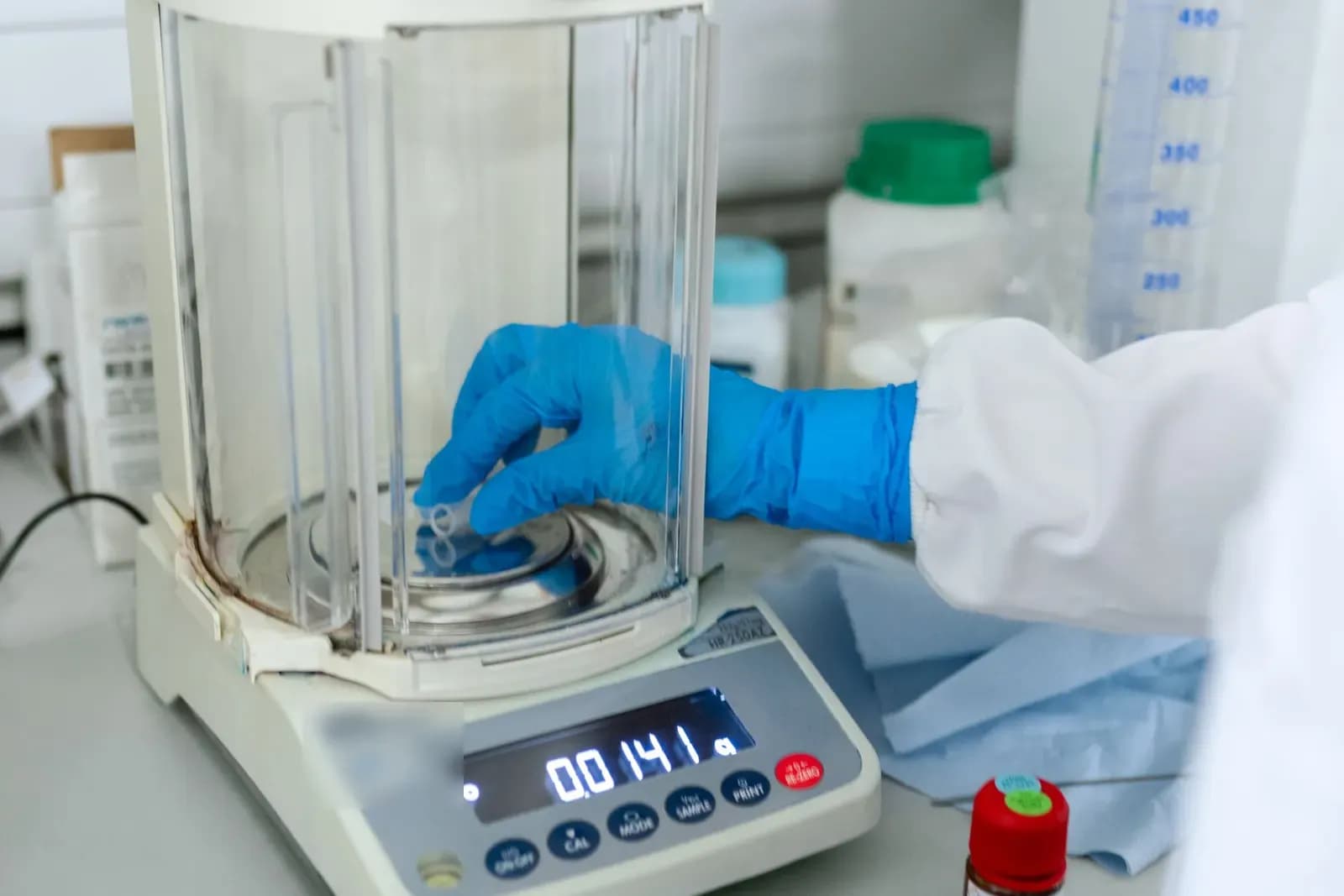
Records are a truthful, correct representation of what happened. Accuracy comes from qualified equipment, validated calculations, second-person checks where the risk justifies them, and a culture in which people report errors.
- Paper: a critical manual weighing is verified by a second person who witnesses the reading, not by someone who checks the arithmetic afterwards.
- Electronic: the balance sends the weight straight to the system, so the value is not retyped.
Complete
All data needed to reconstruct the activity are present, including repeats, failed runs and metadata. The EMA guideline makes clear that completeness includes the audit trail.
- Paper: spoiled or replaced forms are kept with a written reason, not thrown away. FDA's 2018 Q&A says this explicitly for incomplete or erroneous forms.
- Electronic: aborted runs and reprocessed results remain visible in the system.
Consistent
Data are recorded in the same way across the whole data life cycle, and the sequence of events makes sense. Dates and times follow a logical order, formats are standardised, and the same definitions apply everywhere.
- Paper: one date format across all forms, and timestamps that do not show a review signed before the work was done.
- Electronic: controlled master data and picklists instead of free text for key fields.
Enduring
Records survive for the full retention period without loss or damage.
- Paper: no thermal paper printouts left to fade. PIC/S expects signed and dated true copies of these. Archives are protected against fire, water and pests.
- Electronic: validated backups, tested restores and a documented archiving approach. EU GMP Annex 11 (clause 17) expects archived data to be checked for accessibility, readability and integrity.
Available
Records can be retrieved for review, audit or inspection when needed, throughout the retention period.
- Paper: an index tells you where each record is stored, and retrieval within an inspection day is realistic.
- Electronic: authorised reviewers can search and export the data and its audit trail without asking the vendor.
Traceable (ALCOA++)
Every change to the data or its context can be followed from the original value to the current one, with who, when and why. Traceability is what links all the other attributes over time.
- Paper: corrections show the original value, the new value, initials, date and reason.
- Electronic: a computer-generated audit trail records the old value, new value, user, timestamp and reason for each GxP-relevant change.
Typical data integrity failures
Inspection findings tend to repeat the same patterns. These are the ones a small company should look for first:
- Shared or generic logins. FDA's Q&A explains that shared credentials make it impossible to identify a unique individual. The MHRA and WHO guidance both say shared logins should not be used for systems that generate, amend or store GxP data. Read-only shared accounts for viewing are a different case.
- Back-dated or pre-filled entries. Examples include a cleaning log completed at the end of the week, or a training record signed after the procedure was already in use. Both break the contemporaneous principle.
- Uncontrolled blank forms and spreadsheets. FDA's Q&A expects blank forms to be controlled and, where appropriate, issued as numbered sets and reconciled. Uncontrolled spreadsheets used for GxP calculations raise the same questions: who changed the formula, which version was used, and where is the original data?
- Audit trails that are switched off, deletable or never reviewed. The MHRA guidance states that users should not be able to amend or switch off the audit trail. If an administrator does so, that action itself should be recorded.
- Administrator rights for everyday users. People who generate data should not also be able to delete it or change system settings.
- Results selected after the fact. Running a test until it passes and reporting only the passing result breaks the complete principle.
When you find one of these, handle it as a deviation with a root cause and CAPA, not as a quiet fix. Our articles on GMP deviation management and CAPA effectiveness checks cover the follow-up.
What regulators expect from audit trail review
An audit trail only protects data if someone looks at it. The main expectations are consistent across guidance documents:
- Review it as part of the record. FDA's 2018 Q&A compares audit trail review to checking cross-outs on paper. The people responsible for reviewing a record should review the audit trail entries that relate to it.
- Set the frequency by risk. Where a regulation already defines when data must be reviewed, such as before batch release, FDA expects the same frequency for the audit trail. Otherwise, set the frequency through a risk assessment. WHO TRS 1033 points to system criticality and the type of audit trail information as factors.
- Focus on what matters. The MHRA notes that audit trail review need not include every system event, such as log-ons. It allows exception reports that flag predefined unusual events. The EMA clinical trials guideline asks for risk-based reviews focused on critical data.
- Leave evidence. WHO TRS 1033 expects evidence of the review to be kept, and a documented, signed and dated conclusion where one is required.
- Keep it reviewable. EU GMP Annex 11 (clause 9) expects audit trails to be available, convertible to a generally intelligible form and regularly reviewed. The draft revision of Annex 11 goes into more detail. See our summary of the EU GMP Annex 11 revision.
A practical approach for a small team: list your GxP systems, rank them by data criticality, and define in an SOP what is reviewed, how often, by whom, and what counts as an exception. A spot check during each batch or record review, plus a periodic review of administrator activity, is a common starting point.
ALCOA+ self-check list
Use these questions for a quick walk-through of one process, from the paper records to the system:
- Does every person who records or approves GxP data have an individual login?
- Can anyone edit or delete data without leaving a trace? Who has administrator rights?
- Are corrections on paper single-line, signed, dated and explained?
- Are blank forms issued and reconciled, and are logbooks bound and paginated?
- Are records completed at the time of the activity, and do timestamps confirm it?
- Do you know which record is the original for each process, especially in hybrid paper and electronic set-ups?
- Are spreadsheets used for GxP calculations locked, version-controlled and verified?
- Is there a defined, risk-based audit trail review, with evidence that it happens?
- Have you tested restoring data from backup in the last year?
- Can you retrieve any record and its history within the time an inspector would reasonably wait?
- Do training records show staff were trained on good documentation practice and data integrity? Our GxP training matrix guide can help.
If several answers are "no" and your records are mostly paper, our paper-to-eQMS migration plan may be a useful next read.
Next step
Pick one high-risk process, such as batch record review or a laboratory system, and run the self-check above with the people who do the work. If you decide an electronic system would help with controlled documents and quality records, QFacts is one option. It keeps a full audit trail on documents, with version history and electronic signatures, and access is based on user roles. You can try it on your own workflows during the 14-day free trial on the pricing page. Whichever system you use, the ALCOA+ attributes still depend on your procedures and on how people work.
Sources and further reading
- Data Integrity and Compliance With Drug CGMP: Questions and Answers (December 2018)U.S. Food and Drug Administration
- GxP Data Integrity Guidance and Definitions (Revision 1, March 2018)Medicines and Healthcare products Regulatory Agency (MHRA)
- PI 041-1: Good Practices for Data Management and Integrity in Regulated GMP/GDP Environments (1 July 2021)Pharmaceutical Inspection Co-operation Scheme (PIC/S)
- WHO Technical Report Series No. 1033, Annex 4: Guideline on data integrity (2021)World Health Organization
- Guideline on computerised systems and electronic data in clinical trials (EMA/INS/GCP/112288/2023)European Medicines Agency
- EudraLex Volume 4, EU GMP Guidelines, Chapter 4: Documentation (revision 1, 2011)European Commission
- EudraLex Volume 4, EU GMP Guidelines, Annex 11: Computerised Systems (2011)European Commission
- Stakeholders' consultation on EudraLex Volume 4: Chapter 4, Annex 11 and new Annex 22 (July to October 2025)European Commission
Try QFacts with your own quality workflow.
Get new articles by email
Practical guidance on quality management and compliance, delivered to your inbox.